Ask our patients what they notice first after Follistatin gene therapy, and the answer is rarely what you would expect. It is not a number on a scan. It is a feeling — that they are standing a little taller, that walking takes less effort, that holding themselves upright through a long day no longer requires thought. Their core feels, again, like it is doing its job.
For a long time, that was treated as a pleasant side note. The research on how we age suggests it may be one of the most meaningful things we can offer at all.
Posture is not cosmetic
For decades, a rounded, forward-curved posture — what clinicians call hyperkyphosis — was quietly filed under “things that happen when you get old.” Then researchers began following older adults for years at a time, watching what actually became of them.
Stanford geriatrician Deborah Kado and her colleagues measured posture in more than 1,300 older men and women and tracked them over time. The more hunched a person was, the more likely they were to die sooner — and the excess deaths clustered around the lungs, as a collapsed chest leaves less room to breathe.
The natural objection is that posture is merely a marker of weak bones. Kado’s team tested exactly that. In a second study of 610 women followed for more than thirteen years, greater curvature predicted earlier death even after accounting for bone density and spinal fractures. Posture, in other words, carried a risk of its own — beyond the bone.
What actually holds you up
So what collapses posture as we age? Two systems, working together.
The first is bone. Roughly two-thirds of spinal compression fractures never come to medical attention — people accumulate them silently, losing height and curving forward without ever knowing. These fractures are not harmless: women with vertebral fractures carry a higher mortality rate, and the risk climbs with each additional fracture.
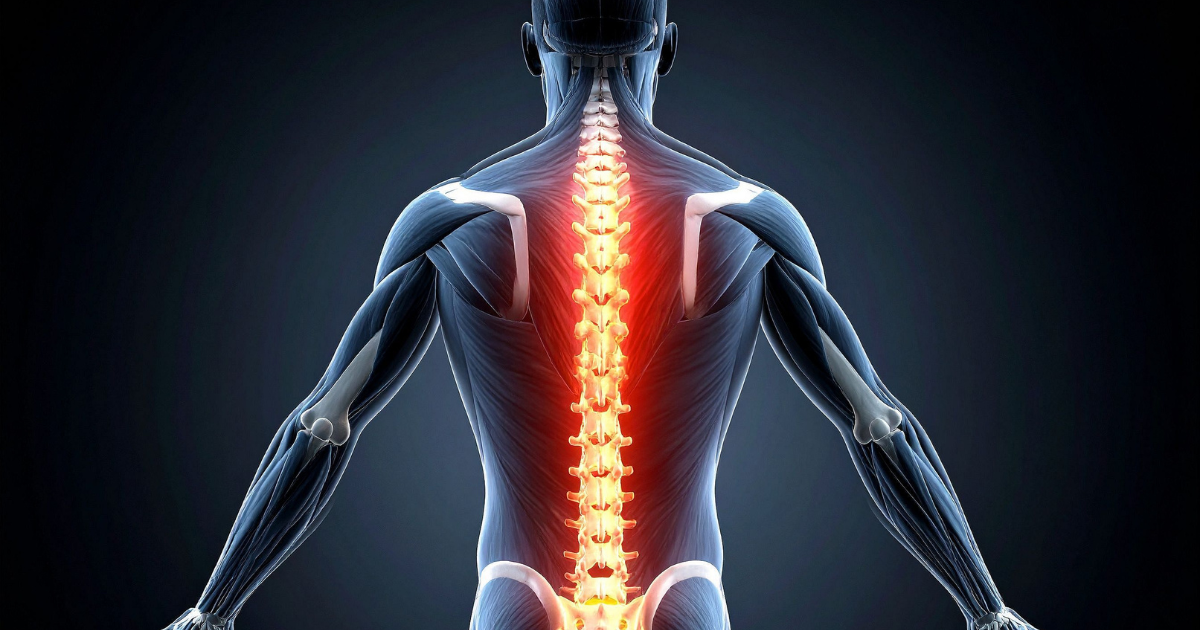
The second — and the one most often overlooked — is muscle. Your posture is held not by the skeleton alone but by the muscles wrapped around your spine and core. As those muscles thin with age (a process called sarcopenia), the scaffolding that keeps you upright weakens. And it is not only size that fades. Muscle power — the ability to produce force quickly — declines faster than raw strength, and it is power that lets you catch yourself when you stumble.
That matters enormously, because falls are the leading cause of injury-related death in adults over 65, and that death rate has been climbing, not falling. One in six women will break a hip in her lifetime, and roughly one in five of those will not survive the year that follows. Reduced muscle strength sits near the top of every list of risk factors.
The good news the research keeps confirming
Here is the part worth holding onto: muscle answers, at any age.
In a landmark study, frail nursing-home residents with an average age of 90 trained their muscles for eight weeks. Their strength rose by an average of 174 percent, their thigh muscle grew, and their walking speed improved by nearly half. People who had needed a cane could rise from a chair unaided. The aging body, it turns out, never stops responding to a reason to get stronger.
Where Follistatin comes in
This is the biology Follistatin gene therapy speaks to directly. Muscle growth is held in check by a protein called myostatin — in effect, the body’s brake on muscle. Follistatin is a natural inhibitor of myostatin. By raising follistatin, the therapy eases that brake, allowing muscle to build and be maintained more readily. And unlike our localized therapies, follistatin acts systemically — its influence reaches muscle throughout the body, including the deep postural and core muscles that carry you upright.
That, we believe, is why posture is so often the very first thing our patients feel. The therapy does not straighten the spine; stronger postural muscles simply do a better job of carrying it. Easier to walk, easier to hold the core, easier to stand tall through a long day — these are precisely the changes you would predict when the muscular scaffolding is reinforced.
And the bones?
A fair question we hear often: does Follistatin help bone, too?
The honest answer is that muscle and bone are deeply connected — in a real sense, they are one working unit. Stronger muscles pull harder on bone, and bone responds by growing denser; heavy resistance training in older adults with low bone mass adds measurably to spine density for exactly this reason. In animal studies, blocking myostatin produces denser, stronger bone, and follistatin has been shown to accelerate bone healing.
The muscle-building evidence for follistatin is strong; the direct bone-building evidence, in humans, is still emerging. And that is precisely where our approach has an answer — because we never rely on follistatin alone. Where Follistatin rebuilds the muscle that carries your frame, our PSC-derived exosomes work directly on bone and tissue repair. One addresses the muscular side of posture; the other addresses the structural side. Together, they cover both — which is exactly how they are meant to be used.
A foundation, not a fountain
This is why we describe our therapies as a Foundation rather than a fountain of youth. We are not claiming to add years to your life. We are working to give back the biological foundation — muscle, posture, power, the ease and confidence of moving through an ordinary day — that lets you live the years you have more fully.
And it is why our therapies are designed to work together: Follistatin to strengthen the muscle that holds you up, our pluripotent-derived exosomes to restore the bone beneath it. Muscle and structure, addressed as one — each doing what it does best, so that standing tall is supported from every direction.
The research behind this article
- Kado DM, Huang MH, Karlamangla AS, Barrett-Connor E, Greendale GA. Hyperkyphotic posture predicts mortality in older community-dwelling men and women: a prospective study. J Am Geriatr Soc. 2004;52(10):1662–1667.
- Kado DM, Lui LY, Ensrud KE, Fink HA, Karlamangla AS, Cummings SR. Hyperkyphosis predicts mortality independent of vertebral osteoporosis in older women. Ann Intern Med. 2009;150(10):681–687.
- Fiatarone MA, Marks EC, Ryan ND, Meredith CN, Lipsitz LA, Evans WJ. High-intensity strength training in nonagenarians: effects on skeletal muscle. JAMA. 1990;263(22):3029–3034.
- Centers for Disease Control and Prevention. Older Adult Falls Data. Falls are the leading cause of injury-related death among adults aged 65 and older (fall death rate 78.4 per 100,000 in 2024).
- International Osteoporosis Foundation. Epidemiology of osteoporosis and fragility fractures. (Approximately one-third of vertebral fractures come to clinical attention.)
- McCarthy J, Davis A. Diagnosis and management of vertebral compression fractures. Am Fam Physician. 2016;94(1):44–50. (Vertebral fracture and mortality; risk rising with number of fractures.)
- Osteoporosis in Females. StatPearls; and Ebell MH. Predicting hip fracture risk in older women. Am Fam Physician. (Lifetime hip fracture risk ~1 in 6; one-year post-fracture mortality ~20–24%.)
- Muscle power and falls: muscle power declines faster than strength with age and is a strong predictor of fall risk in community-dwelling older adults (J Biomech, 2022; systematic reviews of power training).
- Watson SL, et al. LIFTMOR / LIFTMOR-M trials: high-intensity resistance and impact training increased lumbar spine bone mineral density (~2–4%) in postmenopausal women and older men with low bone mass.
- Follistatin–myostatin–activin axis and bone: myostatin knockout increases bone mineral density and strength (animal); follistatin accelerates bone regeneration in animal models; human and follistatin-specific evidence remains scarce and mixed (Sci Rep 2017; JBMR Plus 2021; Pediatrics/BMD association studies; ScienceDirect 2012).
This article is educational and does not constitute medical advice or a claim to treat, cure, or prevent any disease. Individual responses vary. Human evidence and animal evidence are noted distinctly throughout.